01
Product knowledge
Specifications, ingredients, certifications, pricing and compliance — different for every market. One agent per market, the same catalogue underneath.
AI agents for companies that already run on real systems
Your ERP, your BI, your documents, your mailbox. We connect them to agents your people ask in plain language — and that hand back the spreadsheet, the report, the answer.
No migration. Read-only by design. Your servers or ours.
Your systems
Nnaico
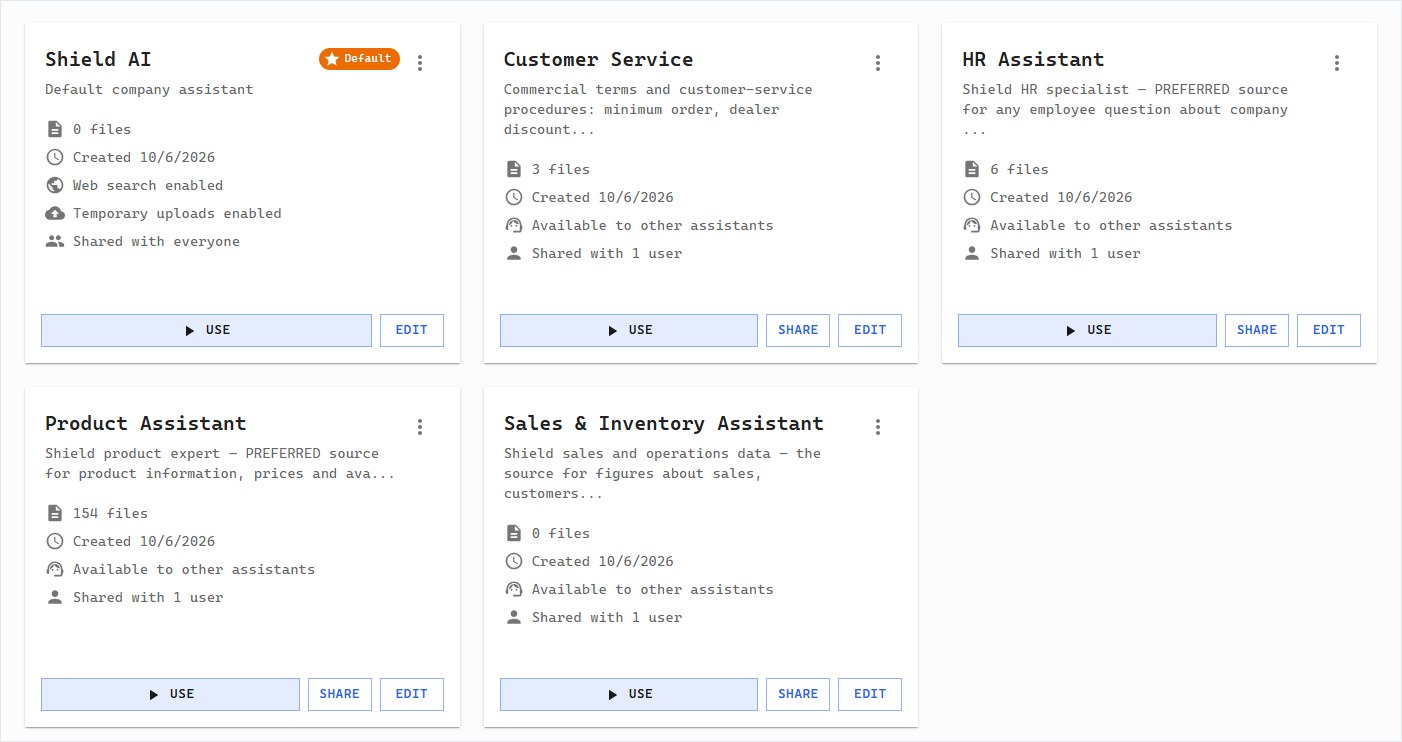
Agents built for your business
Your people
What we connect
The data is already there, and it is good. What costs you is the time it takes to reach it.
01
Specifications, ingredients, certifications, pricing and compliance — different for every market. One agent per market, the same catalogue underneath.
02
Sales, stock, margins and orders, read straight from your ERP and BI in plain language. Divided by role, so each person sees only their own perimeter.
03
Decisions, trials and the reasons behind them, linked in a knowledge graph. The history that today lives in people's heads and walks out of the door with them.
In practice
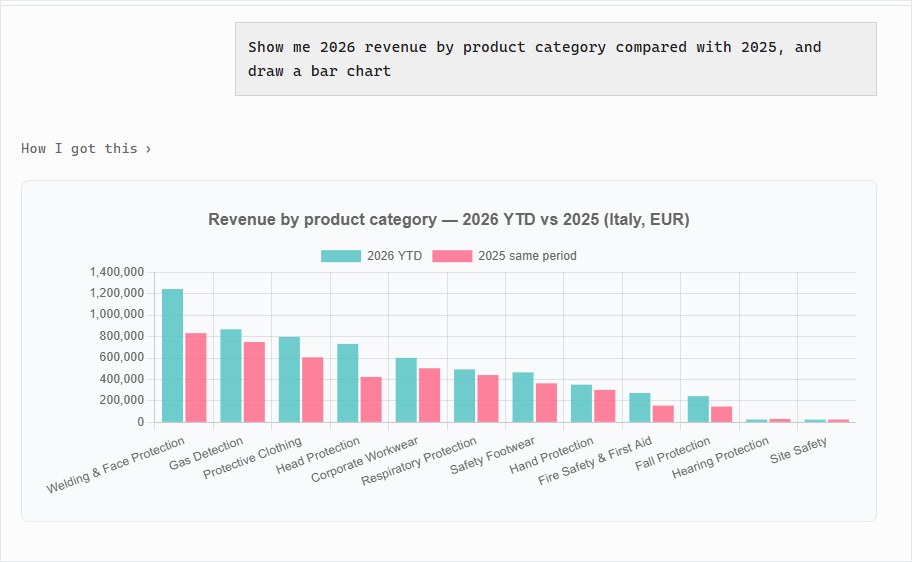
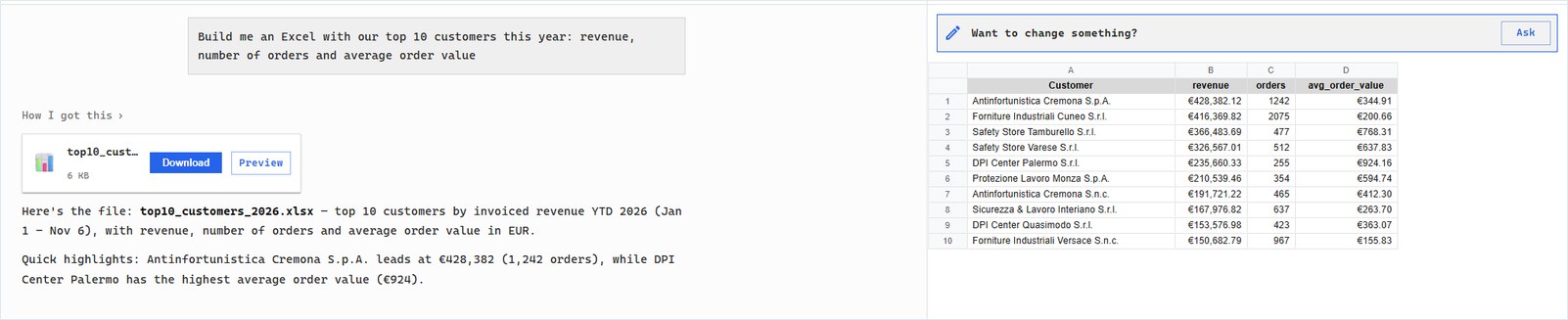
Not a chat that summarises. An agent that queries the real data and hands back the file.
What we solve
Every one of them came from a real conversation with a client.
It is in the ERP, or a folder, or someone's head. Finding it is the job.
Agents read all of it and answer in plain language, citing the document the answer came from.
BI answers what it was built to answer. The new question needs a new report.
Ask the question you actually have. The agent queries live data and builds the chart on request.
Why a formulation was abandoned in 2019 is known by one person. If they retire, nobody knows.
A knowledge graph keeps decisions, trials and the reasons behind them, linked and searchable.
Most tools can see whatever the account can see, and you are trusting the model to behave.
Permissions are set per role at table level, outside the model. Every query is logged and auditable.
A reply in a chat window still has to become a spreadsheet, a report, an email.
Agents produce the file: Excel, Word, PDF, slides, charts — formatted and ready to send.
Requirements move faster than tickets, and the tool ages until nobody uses it.
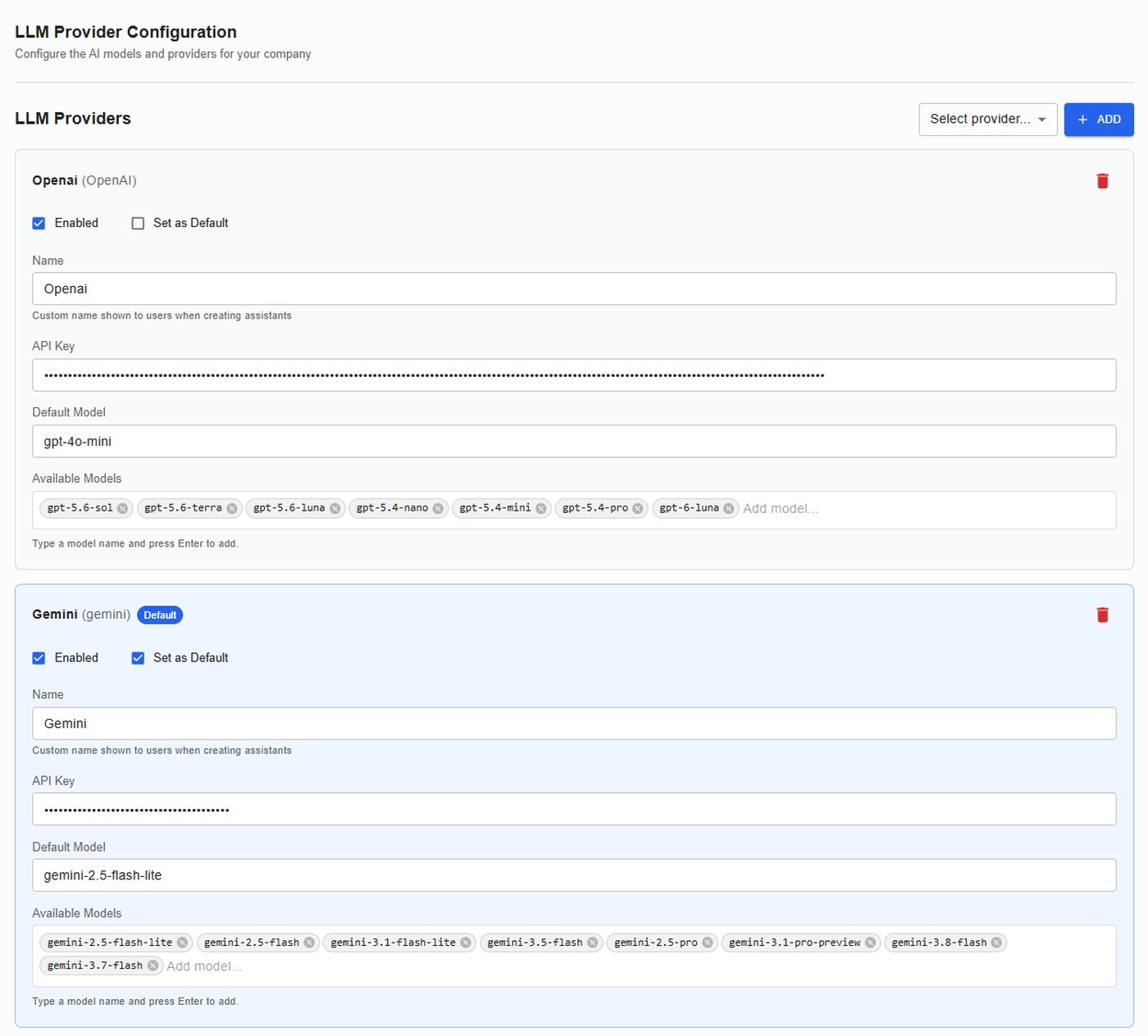
You change instructions, data access and permissions yourself, from a panel, without writing code.
Email and automation
Across our clients, email turns out to be the heaviest workload of all — and the one people feel every day.
“That quote we sent a Spanish distributor about two years ago, the one with the special packaging.” No sender, no subject, no date — and it comes back with the thread and the attachment.
Long threads become three lines. Replies are drafted using your product data and your previous answers — with read-only permissions you configure, so nothing is sent without a person deciding.
You work out what you want in conversation, then schedule it: “repeat this every Monday morning.” No configuration screen — the recurrence is asked for in words, like everything else.
Which clients matter, what counts as urgent, how you want figures presented. Preferences you state once are applied from then on.
“Every evening at six, send me a summary of the emails I have not replied to, sorted by how urgent they really are.”
Said once, in a sentence. It runs every evening from then on — and the definition of “urgent” is yours, not ours.
For your IT team
They are the right questions, and we have been asked them before.
Where it runs
What it touches
What it costs you
Get in touch
Half an hour on a call, and we show you a system already running in production. If it does not earn its place, it stops there — nothing was migrated, so there is nothing to unwind.